
District Calendar
This Week's Menus
Staff Directory
NEISD School Sub Column 2nd Level
layout-sub-column-2nd-level
skip to main content
North East Independent School District

Parent Clinic Information

Allergies

Allergy Action Plan
To be used for all students with severe allergic reactions who will have emergency medication (for example, Epi Pens or Benadry) in the clinic.

School Meal Modification Form 2026-2027
Meal Modification Request

Asthma

American Lung Association Self-Carry, Self-Administer Assessment Tool
(online assessment tool) to determine if your student is ready to self carry

Asthma Action Plan
This form is critical in addressing onset of symptoms quickly and efficiently. Asthma control can change quickly- everyone needs to be on the same page (home and school)

Asthma Parent Information Self Carry Inhaler
Information on the process for students with asthma to self-carry per Texas Law

How to avoid the September Asthma Peak
Asthma flares requiring a hospital or ER visit tend to spike in early-to-mid September. Why does it happen? How to be proactive and preventive to avoid a flare?

NEISD Authorization to Self-Carry and Student Agreement
This form is required for students to self carry inhaler on campus.

Parent handout of Self-Carry Assessment Tool
Self Carry is the Law: is your 5th grade child ready to self carry?

Asthma Awareness Education

Diabetes

Diabetes: Authorization for Self Management
This form is required for diabetic students who have physician authorization to self-manage while at school or at school-related activities.

Diabetes Treatment Plan
This form is required for all diabetic students who will need nursing care or supervision of their diabetes throughout the school day and at school related activities.

Seizures

Seizure Action Plan
This form is required for all students with a seizure disorder who may require emergency medication at school or at school related activities.

Bacterial Meningitis

What is meningitis?

Meningitis is an infection of the fluid surrounding the brain and spinal cord. It is usually caused by viruses, bacteria, parasites, and fungi. Viral meningitis is the most common and least serious. Most people completely recover from viral meningitis. Parasitic and fungal meningitis are very rare. Bacterial meningitis is very serious and may involve complicated medical treatment.

What are the symptoms?

Someone with meningitis will become very ill but not everyone with meningitis will have the same symptoms. The illness may develop over one or two days, but it can also progress very rapidly in a matter of hours. Children (over one year old) and adults with meningitis may have a severe headache, high temperature, nausea, vomiting, sensitivity to bright lights, neck stiffness or joint pain, drowsiness, or confusion. In both children and adults, there may be a rash or tiny red-purple spots that can occur on any part of the body.

How is bacterial meningitis diagnosed?

The diagnosis of bacterial meningitis is based on a combination of clinical symptoms and the results of laboratory tests.

How serious is bacterial meningitis?

Bacterial meningitis is a very serious disease. If it is diagnosed early and treated promptly, most people make a complete recovery. Even with prompt treatment, some cases may result in permanent disabilities such as loss of hearing, loss of vision, intellectual disabilities, paralysis, or limb amputations. Bacterial meningitis can also be fatal.

How does bacterial meningitis spread?

Fortunately, none of the bacteria that cause meningitis are as contagious as diseases such as the common cold or flu. They are not spread by casual contact or by simply breathing the air where a person with meningitis has been. The germs that cause meningitis live naturally in the back of our noses and throats, but they do not live for long outside the body. They are spread when people exchange saliva (such as by kissing, sharing drinking containers, eating utensils or cigarettes). The germ does not cause meningitis in most people. Instead, most people become carriers of the germ for days, weeks or even months. Being a carrier helps stimulate the body's natural defense system. The bacteria rarely overcome the body's immune system to cause meningitis or serious illnesses.

How can bacterial meningitis be prevented?

Bacterial meningitis can be prevented by limiting the number of people you kiss and by not sharing food, drinks, utensils, toothbrushes, or cigarettes.
Vaccines that help prevent meningitis are required for young children, if there is a meningitis outbreak in the community, and for people traveling to foreign countries where there is a high risk of getting the disease. A vaccine that can prevent meningitis in adolescents and young adults is state mandated for students in grades 7 - 12 and a second dose is required for all incoming college freshmen or college students between the ages 19-21. The vaccine is safe and effective (85%-90%). It can cause mild side effects such as redness and discomfort at the injection site lasting up to two days.

What should you do if you think you or a friend might have bacterial meningitis?

You should seek medical attention immediately.

For more information about bacterial meningitis:

Your school nurse, family doctor, and the staff at your local or regional Texas Department of State Health Services office are excellent sources of information on all communicable diseases and vaccines. Additional information may also be found at the web sites for the Centers for Disease Control and Prevention: www.cdc.gov and at the Texas Department of State Health Services: www.dshs.state.tx.us.
Medication Policies
Please keep the following guidelines in mind when bringing medications:
Medication will not be accepted without the required physician/parent authorization. For general medication to be given at school, a physician signed Medication Administration Request Form is required (found below).

All medication must be in the original prescription or over-the-counter container. Medication brought to the clinic in containers such as, but not limited to, plastic wrap or bags, foil, jars, paper towels, envelopes, etc. will NOT be administered. ALL medications shall be delivered to and kept in the school clinic. Medications may not be kept in the classroom or administered by a teacher in the classroom.
 
 
Medication/Treatment Request Forms
Community Resources Information
 

City of San Antonio Asthma Home Visit Program

Anyone can refer!  

Immunizations: Where to go?

Immunizations: Where to go?
Go to this search engine to find where vaccines are avalible near you! Getting vaccinated is convenient — you can get most recommended vaccines at your doctor’s office. Many recommended vaccines are also available at local pharmacies, health centers, health departments, and travel clinics.

Medication Assistance Programs

Texas Rx Card  The program is designed to help patients nationwide who do not have prescription drug coverage or who have coverage but are subject to large deductibles, large co-pays, formulary limitations, dosing limitations, gaps, and/or any cash out-of-pocket expenses.
Good Rx   Stop paying too much for your prescriptions. How GoodRx Works: In less than 90 seconds, see how GoodRx provides prices and discounts for prescription drugs to save you up to 80%.

Parent Information on Vaping

escape the vape
The usage of e-cigarettes among adolescents has dramatically increased over the past several years*.  Marketing campaigns by e-cigarette companies are designed to attract young people and do not reveal the hazards, potential hazards and the addictive nature of their products**. E-cigarrettes contain nicotine (addiictive chemical found in cigarettes) and will introduce young people to nicotine and keep them addicted. The products' design are appealing to youth and can go un-noticed by  parents  -  did you know that USB stick might be an E-Cigarette? 
We want to offer parents the latest research and information so they may make informed decisions. 
If your child has already been introduced to nicotine it may be difficult for them to stop.  Nicotine is highly addictive and can harm brain development, which continues until about age 25***.  There are resources to help your child quit;  such as the QuitSTART app and Taking Down Tobacco or Smokefree Teen online programs. 
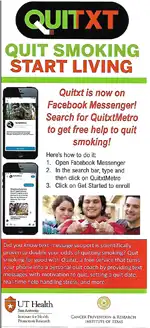
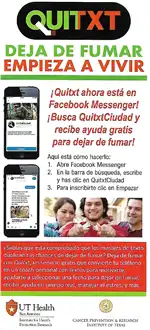
Quit Smoking Cessation with texting     Quit Smoking Cessation text (Spanish)
* Centers for Disease Control and Prevention
** MMWR October 2015
*** Surgeon General library reports

The Flu: A Guide for Parents