




Screentime
What is Screen Time?
The American Academy of Pediatrics (AAP) defines screen time as any time spent watching screens, including smartphones, tablets, gaming consoles, TVs, and computers.
Not All Screen Time is the Same
In our district, we believe technology is a powerful tool to enhance your child's learning experience. However, we are mindful that not all screen time is created equal! The US Department of Education stresses the importance of active versus passive use of technology rather than focusing on time spent on devices.
To maximize learning, we are equipping our staff with best practices for active screen time to help guide intentional, engaging, and purposeful technology use that centers human connection and critical thinking skills.
Active screen time look like...

Collaboration

Creation

Support Thinking

Problem-solving

Informed Instruction
Passive screen time looks like...

Consuming

Entertaining

Isolating

Giving Answers

Not Interactive
The 5 Cs of Media Use
The American Academy of Pediatrics Center of Excellence on Social Media and Youth Mental Health has developed a new approach to monitoring screen time.
The 5 Cs media use guidance offers easy-to-remember, age-based tips. It's based on research and what we know supports family relationships, social-emotional development and mental health.
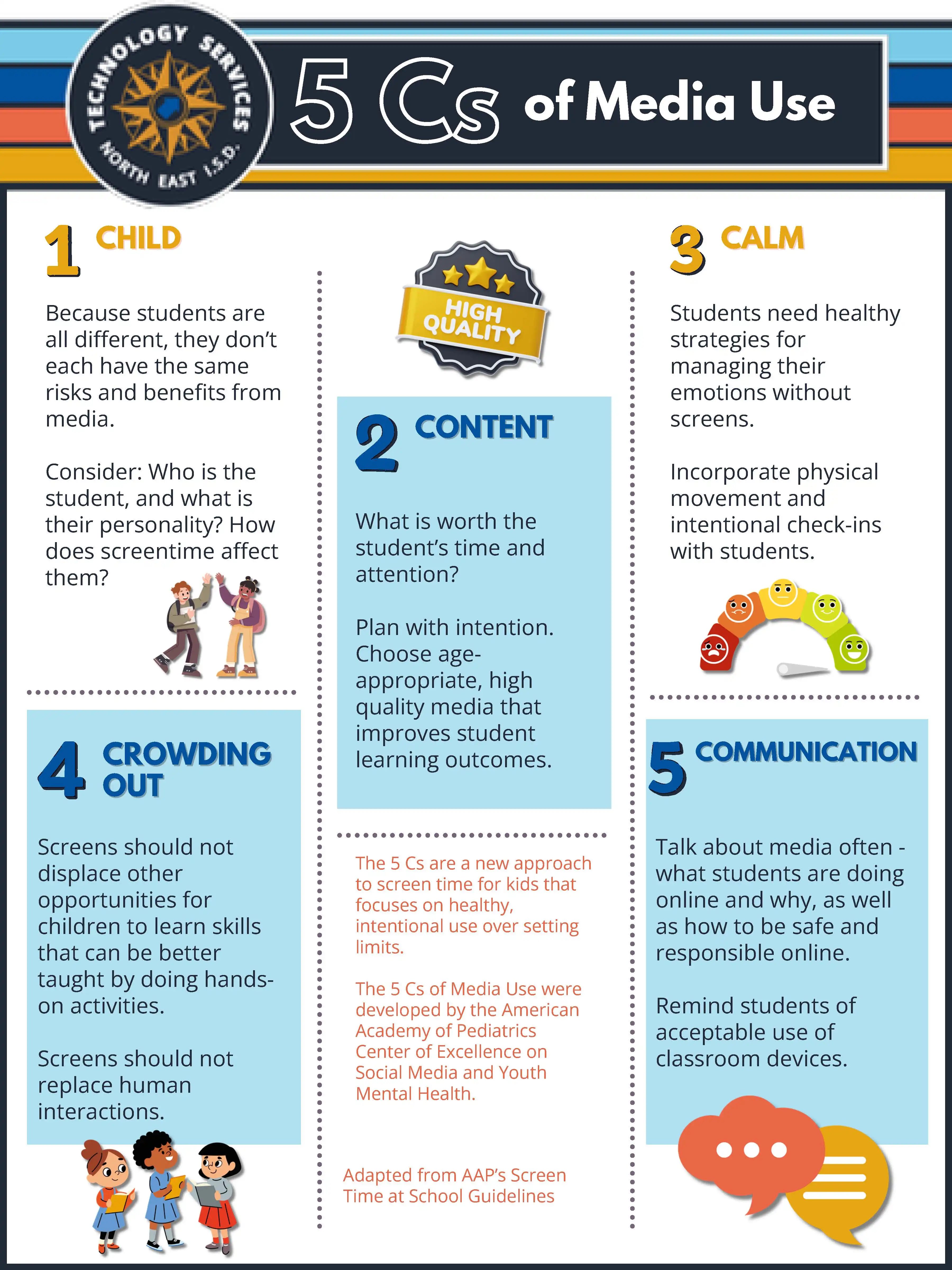
Screen Time Resources for Parents and Families
Additional Tips for Families
Take Breaks: Encourage breaks every 30-60 minutes to rest the eyes and reduce strain. Physical activity during breaks is also helpful.
Create Screen-Free Zones: Designate certain areas in the home where screens are not allowed, such as bedrooms or mealtime.
Model Good Behavior: Lead by example and reduce your own screen time. Spend quality time with your family doing non-screen-related activities.
Use Screens for Educational Purposes: Encourage using screens for learning and educational purposes. Encourage kids to play educational games, and watch documentaries or educational videos.
Take an active role: Watch things with them and discuss your family values.
Feedback from Stakeholders
My data shows that with my intentional planning for meaningful student device use, student scores go up and they have learning growth. Last school year, I had a 99% passing rate on STAAR (including students who have never passed), and I do believe a big part of that is with the tools and resources I have made available digitally.
I had a parent last school year who was in tears of joy from how their child actually wanted to read because of the digital projects we were doing in my class.
-M. Villa
NEISD Middle School Teacher
I had a parent last school year who was in tears of joy from how their child actually wanted to read because of the digital projects we were doing in my class.
-M. Villa
NEISD Middle School Teacher
Intentional student use of devices has helped improve learning outcomes by giving me more opportunities to see student thinking in real time and quickly adjust instruction based on what I am seeing. It allows me to be more responsive to my students and helps more students make progress toward the learning goal.
I have also seen an increase in student engagement, independence, and confidence in their learning. Students are not just waiting for me to tell them whether they are right or wrong - they are able to check their work, reflect, and make adjustments. Students are so excited when they recognize their own growth and are excited to share.
-A. Flores
NEISD Elementary Teacher
I have also seen an increase in student engagement, independence, and confidence in their learning. Students are not just waiting for me to tell them whether they are right or wrong - they are able to check their work, reflect, and make adjustments. Students are so excited when they recognize their own growth and are excited to share.
-A. Flores
NEISD Elementary Teacher
At North East ISD we are dedicated to providing our students with a world-class education that equips them with the skills and knowledge needed to thrive in an ever-evolving digital landscape. We recognize the transformative power of technology and its potential to enhance learning experiences. Thus, we hereby commit to the purposeful integration of technology in our classrooms.